Fillers & Volume
Korean Under Eye Filler: Hollows vs Bags
Korean under eye filler softens a tear-trough hollow but rarely helps a puffy fat bag. See who it suits, the real risks, and how to plan days in Seoul.
 Dr. Sarang LimHead Doctor, Muse Clinic Myeongdong · 11 min readMedically reviewed by Sarang Lim, M.D., Head Doctor · Edited by: Sarang Lim, M.D.
In this article
- 01What is Korean under eye filler, and how does it work?
- 02The shadow is often a hollow, and the puff is often fat
- 03Who does under eye filler usually suit?
- 04Why would a doctor say no to under eye filler?
- 05Migration, swelling and a bluish tint: the risks to know
- 06What do the first days look like if you fly home soon after?
- 07What happens on the day at Muse Clinic Myeongdong
- 08What to bring, and what to send first
If you typed “korean under eye filler” hoping it would fix tired-looking eyes, here is the short answer: a small amount of soft hyaluronic acid gel placed along the tear trough can soften a hollow, but it rarely helps a puffy fat bag and can make one look bigger. Which of the two you have is most of the decision. The worry most visitors bring is practical: what if it bruises right before the flight home, or looks lumpy a month later when the clinic is in another country?
At Muse Clinic Myeongdong, English, Japanese and Chinese interpreters are in the clinic, and someone stays with you from consultation through treatment. For under-eye work that matters, because the reasons behind a yes or a “not for you” are small anatomical details you'll want to follow clearly.
Before you book a flight around it, send one daylight photo of your under-eye area on WhatsApp, taken straight on with no makeup and your eyes looking ahead, plus the dates you'll be in Seoul. With your face and your schedule in one thread, the consultation starts from your own situation, and you can plan the rest of the trip around a real appointment.
What is Korean under eye filler, and how does it work?
Korean under eye filler is hyaluronic acid gel injected in small amounts into the groove where the lower eyelid meets the cheek, called the tear trough. It lifts the floor of the hollow so less shadow falls there. The gel binds water and sits under the skin as soft support.
The word “Korean” describes where it's done, not a different substance. The American Society of Plastic Surgeons groups fillers by material, with hyaluronic acid, calcium hydroxylapatite and poly-L-lactic acid among the main types. For the thin skin under the eye, a soft hyaluronic acid gel is the usual choice, largely because it can be dissolved if it sits wrong.
The skin is what makes this area demanding. Lower-lid skin is much thinner than cheek skin, so gel placed too shallow can show as a ridge or a faint bluish tint. Injectors usually place it deeper, close to the bone, in smaller amounts than they would use in cheeks or lips, with a fine needle or a blunt cannula. The aim is a smoother line from lid to cheek. A fuller-looking eye is a sign something went too far.
At Muse Clinic Myeongdong this sits on the menu as under-eye, forehead and nasolabial fold filler, described there simply as filling in under-eye dents.

The shadow is often a hollow, and the puff is often fat
A dark under-eye usually has one or more of three causes: a hollow that casts a shadow, a fat pad pushing forward, or color in the skin itself. Filler addresses only the first. Many people have a mix, which is why the same treatment looks great on one face and heavy on another.
| What you see in the mirror | What's usually behind it | Does filler help? |
|---|---|---|
| A shadow that fades when light hits you head-on | A tear-trough hollow | Often, yes |
| A bulge that grows when you look up | Lower-lid fat pushing forward | Usually no; gel can add to the bulge |
| Puffiness that's worst in the morning | Fluid collecting overnight | Usually no; gel can hold extra water |
| A brown tint that stays in any light | Pigment in the skin | No; that's a skin-tone question |
| Fine crinkles when you smile | Muscle movement on thin skin | Usually no |
You can run a rough version of this at home. Face a window, then tilt your chin down under a ceiling light. If the dark band shows up mainly under the overhead light, it's mostly shadow. If it stays brown in both, pigment plays a bigger part. If the lower lid bulges more when you look toward the ceiling, fat is part of the picture.
The surprise for many people is the last two rows. Crinkly lines that appear with a smile come from muscle pull, and the clinic's anti-wrinkle botulinum toxin menu lists the under-eye and crow's-feet areas for that. If the area looks tired mainly because the skin is thin and dull, the question shifts to skin quality; what a glass-skin plan changes over several sessions covers that side.
Who does under eye filler usually suit?
The clearest candidate has a visible groove, reasonably firm lower-lid skin, little morning puffiness, and only a small fat bulge or none. Adults whose hollow became more noticeable after weight loss or with age, while the lid itself stayed flat, often fit this description.
People who tend to be a weaker fit:
- A prominent fat bag that bulges more when looking up
- Puffiness that comes and goes with salt, sleep or allergies
- Very thin, crepey lid skin where any gel risks showing
- Loose lower-lid skin that springs back slowly after a gentle pull
- An active infection, a skin flare or a recent procedure in the area
- Pregnancy or breastfeeding, when elective injectables are generally postponed
Sometimes the under-eye hollow is partly a shadow cast by a cheek that has descended. In that case, filling the groove alone can look odd, and the real question is support for the midface. Reading what a thread lift changes and what it doesn't is useful before deciding that the under-eye is the whole problem.
Why would a doctor say no to under eye filler?
Usually because the lid shows fat, fluid or loose skin more than a true hollow. Two doctors can look at the same lower lid and disagree, because the call rests on judgment: how much bag is there, and how the skin will carry gel.
If a dermatologist at home told you under-eye filler wasn't a good idea, that opinion deserves weight. They examined your face in person, and many careful injectors are conservative about this area for sound reasons. A different answer in Seoul makes sense only when the exam finds different anatomy, for example a bag that turns out to be small next to a deep groove. If the exam shows the same thing your doctor saw, the answer here should match.
The decision on a lower lid tends to come down to three observations: where the light breaks when you look straight ahead, how much the lid bulges when you look up, and how quickly the skin springs back after a gentle pull. A deep groove over a flat lid is a good setup for gel. A soft bulge with slow snap-back is not, and gel placed there tends to make the eye look heavier. I would rather say that plainly than add volume to a face that doesn't need it.
Migration, swelling and a bluish tint: the risks to know
The common effects are bruising, swelling and tenderness for some days. The ones people worry about later are lumps, a bluish tint, puffiness that lingers, and filler that seems to have spread. Rare but serious is gel entering a blood vessel.
The U.S. Food and Drug Administration lists bruising, redness, swelling, pain, tenderness, itching and rash among common filler side effects. It also warns that unintentional injection into a blood vessel, while rare, can cause skin damage, vision problems including blindness, or stroke. The under-eye region sits close to vessels linked to the eye's blood supply, which is why injectors work slowly, deep and with small volumes there. The American Academy of Dermatology likewise describes bruising and swelling as the usual short-lived effects after fillers.
“Filler migration” is the forum term for gel that ends up looking like it sits outside the groove: a sausage-shaped ridge, or puffiness that's still there months later. In many cases the cause is too much product, placement that's too shallow, or gel drawing water into an area already prone to puffiness. The practical safety net is that hyaluronic acid can usually be broken down with an enzyme, hyaluronidase, if it sits wrong.
A bluish tint, sometimes called the Tyndall effect, can appear when gel lies close to the surface of thin skin. It is typically corrected by dissolving the gel, which takes time and another visit.
Results vary from person to person: how much the hollow softens, how long the gel lasts and how much the area swells all differ with skin thickness, anatomy and the product used. Suitability itself is decided at the in-person exam. One rule applies anywhere in the world: pain that grows instead of easing, skin that turns pale or dusky, or any change in vision after an injection near the eye needs same-day medical attention.
What do the first days look like if you fly home soon after?
Plan for swelling or a bruise for several days, and book the appointment early in your trip, never the day before your flight. On some people an under-eye bruise takes a week or longer to fade completely, so a cushion of quiet days helps.
A sensible shape for a short trip:
1. 2. The next two or three days: low-key sightseeing, sleep with your head a little raised, skip alcohol and hard workouts, follow the aftercare you're given. 3. Before you leave Seoul: look at the area in daylight. If something seems uneven, ask while you can still be seen in person.
Opening hours make this easier to fit around flights: Monday to Friday 10:00 AM to 8:00 PM, and Saturday and Sunday 9:00 AM to 3:00 PM. The clinic is a 1-minute walk from Myeongdong Station Exit 5 on Line 4, so an arrival-day consult rarely needs a long transfer.
The U.S. Centers for Disease Control and Prevention advises medical travelers to get copies of their records and to arrange follow-up care at home before they leave.
If the bruise-before-the-flight question is what's holding you back, send your arrival and departure dates on WhatsApp together with one under-eye photo. Seeing both together makes it simpler to talk about which day of the trip suits a consult and how many quieter days to leave after it.
What happens on the day at Muse Clinic Myeongdong
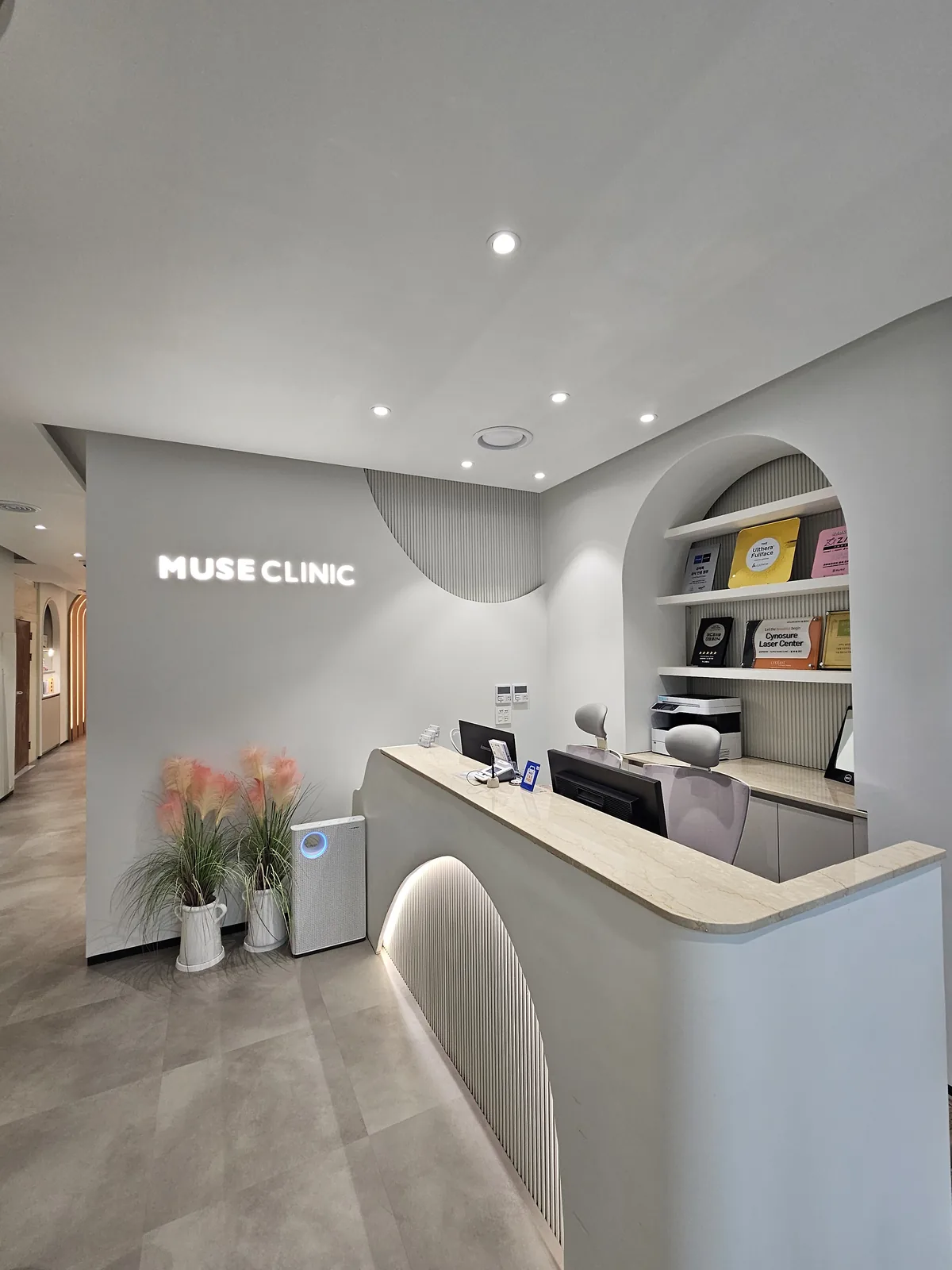
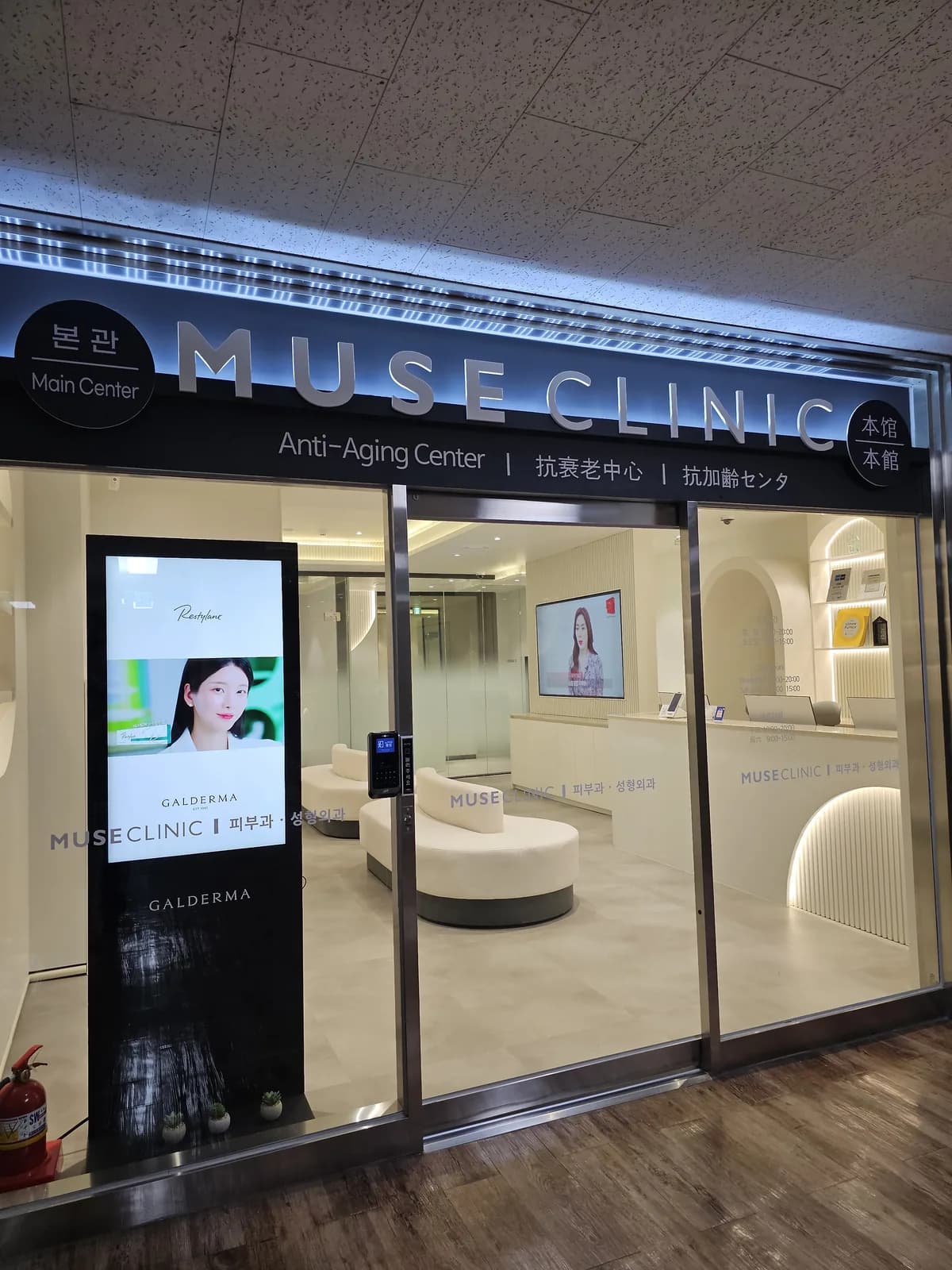
The building has a Twosome Place café and Hana Bank on the 1st floor, which makes it easy to spot.
For filler in general, the order is a consultation, numbing, marking the area, then the injection itself. Ask anything during the consultation, including the uncomfortable questions: what happens if you don't like the result, and what the plan is if a lump appears after you're home.
My training was at Inje University College of Medicine with residency training at Paik Medical Center (Inje University). I'm a member of the Korean Academy of Aesthetic Plastic & Laser Medicine and the Korean Society of Aesthetic Surgery, and I'm listed as a Juvéderm advisory doctor. The full list is on my doctor profile. Muse Clinic has 11 branches in Korea, and this is the Myeongdong branch.
If under-eye filler turns out to be the wrong tool, the rest of the treatment menu is in the same building. For people whose tired look comes mostly from dull, uneven skin, how a clinic facial changes the skin over a few visits is often a gentler starting point.
I understand that hope. What I can offer is a careful look at the same lid, and if I see what your doctor saw, I'll tell you the same thing in plain words.
If you want to ask one thing before planning anything, such as whether the hollow or the bag looks like the bigger part, put that question in a WhatsApp message with your daylight photo.
What to bring, and what to send first
Bring a list of your medications and supplements, since blood thinners and some supplements can make bruising more likely.
Mention them at the consultation rather than on the chair. If you've had filler under the eyes before, bring the date, the area and the product name if you know it; old gel changes how the area looks and how new gel behaves. Arrive without eye makeup if you can.
The first step is smaller than booking: send one question on WhatsApp, such as “Is my shadow a hollow or a bag?”, with a daylight photo of your under eyes and your Seoul dates.
Questions people ask
Before you message us
How long does under eye filler last?
Hyaluronic acid gel breaks down gradually, and the speed differs from person to person and between products. Under-eye gel is often described as lasting many months because the area moves less than the lips, but there is no fixed number. Any top-up makes more sense once the earlier gel has settled, not on a schedule set in advance.
Can under eye filler be removed if I don't like it?
Hyaluronic acid filler can usually be broken down with an enzyme called hyaluronidase. Dissolving takes an in-person visit, and some swelling afterward is common, so if you're traveling, raise any concern while you're still in Seoul rather than waiting until you're home.
Does tear trough filler get rid of dark circles?
Only the part caused by shadow. If your dark circles come from a hollow, softening the groove reduces the shadow. If they come from brown pigment or visible vessels in thin skin, filler won't change the color and can sometimes make thin skin look bluish. Checking your under-eyes under a window and under a ceiling light gives a rough first clue.
Can I fly the day after under eye filler?
Filler is not surgery, and flying itself is generally not the problem. The practical issue is timing: swelling or a bruise can show for several days, and if something looks uneven you want to be seen in person before you leave. Booking the appointment early in your trip and keeping a few quieter days afterward is the more comfortable plan.
Is Korean under eye filler different from filler at home?
The material class is the same hyaluronic acid used widely around the world, and the anatomy rules don't change by country. What differs for a visitor is logistics: language, how many days you have, and follow-up once you're home. Ask for the product name, amount and area in writing so a local doctor can help later if needed.
Results and maintenance period vary by individual. Every procedure carries the possibility of side effects, which are explained before you agree to treatment. Prices exclude 10% VAT and event prices may change. This article is general information from the clinic and is not a diagnosis; suitability is decided at the consultation.
Written by
Dr. Sarang Lim
Head Doctor · Muse Clinic Myeongdong
- Education & training
- Graduated, Inje University College of Medicine · Residency training, Paik Medical Center (Inje University) · Sungkyunkwan University Graduate School, Master's degree · Indiana University Kelley School of Business
- Advisory & certification
- Cynosure — Certified laser center · Juvéderm — Advisory doctor · QT Fill — Advisory doctor · Olidia — Advisory doctor · Galderma Sculptra — Advisory doctor · Merz — Advisory doctor · Jeisys — Advisory doctor · NOVA Thread — Advisory doctor
- Academic societies (full member)
- Korean Academy of Aesthetic Plastic & Laser Medicine · Korean Society of Aesthetic Surgery · Korean Society of Obesity Research Medicine · Korean Society of Obesity & Aesthetic Medicine · Korean Society of Anti-Aging Medicine
Treatments in this article
Excl. 10% VAT · same list Korean patients pay